What an event! And now it's so long ago that I am having trouble remembering every breathless, gushing ounce of praise I was going to level at the internet in Steamcon's favor...
The über highlights!
1. It was the best dressed convention I have ever attended. I have shamelessly 'jacked that sentiment from a good friend of mine who was also in attendance. She's a fashion designer, if that adds the gravid tone I am looking for when I say (write?) so. IT WAS SO WELL DRESSED.
2. It included a badass expo hall full of delicious things to buy. None of which I had money for, but I hovered over things a LOT. Alright, that's a lie. I did buy some home-concocted tea from the wonderful B. Fuller's Mortar & Pestle, based locally in Burien, WA. Mmm, gotta love that home brew.
3. There were many booths for many things, like the bands performing that night, as well as the beloved Dr. Steel.
4. There was an art gallery entirely for Steampunk art and it was also a silent auction! More hovering ensued.
5. One of the panels was Steampunk Ghost Hunting, a tag team between the League of S.T.E.A.M. (who also make a huge cameo in Panic! At the Disco's new single, Ballad of Mona Lisa, available on the excellent album Vices & Virtues) and a....legitimate....Steampunk....Ghosthunting team which I can't recall the name of because I am a DESPICABLE human being!!
6. It included Outlaw Night, which, as I have previously reviewed, featured my personal favorite Steamy band, ABNEY PARK!! HUZZAH!!! Airship pirates, Victorian wenches, and Long Islands were had by all. (except me, I was driving. duh :P)
Now for round two this coming October - Steamcon III: 20,000 Leagues Under the Sea!!
Showing posts with label theatre. Show all posts
Showing posts with label theatre. Show all posts
Sunday, November 21, 2010


Saturday, July 10, 2010
Shakespeare's Merchant of Venice
Entry No. 4 in the Oregon Shakespeare Festival (OSF) 2010 Recollection Series.
This being the first time I have ever encountered this text in any format, I warn you, dear readers: this may look more like musings and ramblings than a review.
I would like to think that Shakespeare wrote this play is order to spur conversation and debate. In fact, I'd wager the true performance here occurs after the curtain call - in the reactions of those who were of late in attendance and applause.
What struck me most was that there was only one character in the main cast who I found truly likable: Basanio. His only fault that I can see was haste without discretion and foolishness to trust a woman he'd not known previously (we must assume, or at least not to any great extent) to love him simply because he won her in accordance with her father's will. But this is pardonable by comparison.
I feel sorry for Antonio that his (in this production) obviously romantic feelings for Basanio came to nothing at all [what is it with Antonios? First the pirate and now this! And both in trade, of sorts. I wonder. Was one or both Antonios (be they perhaps in reference to an original) comparable to a summer's day?] and I feel sorry he resigned himself to die. However, I do not in the least feel sorry for him in light of his blatant prejudice and harmful, open discrimination, "climate of the times" be damned. Likewise, I feel sorry for Shylock's oppression due to his religion and the pain it causes him, but I can by no means pity his open greed and his lack of grief for the loss of his daughter rather than his duckets. And additionally, of Portia I can pity her predicament at being the grand prize in some shell-game contrivance of her father's, but I cannot help but be appalled by all her other dealings in the play: deceiving her husband on a whim, preaching mercy yet showing none, and being constantly swayed by prejudice and hatred.
I fully understand that this is a work more relevant to our times than many would be comfortable with admitting. I can see that, and I openly acknowledge it. As a text it is something which is timeless and thereby invaluable, and I commend all directors, designers, artists, participants for attempting to drive that point home by anachronistic integration (the costumes, for example, were a blend of Renaissance Italy and present-day Europe: my best example will once again be Basanio, who cut a fine figure in a blue leather doublet with detachable shoulders, black riding boots, a white shirt with a button-down collar, and blue jeans): you did your jobs well.
At last I think I come to my point, in a roundabout kind of fashion, as seems to be usual for me now. I think I am so unsettled by this work because although the aim was to have this piece hang somewhere in the interim where past and present are seem at once like two panes of different colored glass held to light [for blue and yellow do indeed make green] in some brilliant stroke of fantasy, the cruelty in the actions and words was all too human, and all too real. So I beseech not only myself, but others, though to few ears and to the world in general, if it had a mind to hear me: learn from that cruelty. Acknowledge it, and know it can bring no good.
But then again, how precious few look to do things for "good"s sake alone.
In short, my readers, a grim kind of not-quite-fiction, human through and through, and absolutely food for thought.
This being the first time I have ever encountered this text in any format, I warn you, dear readers: this may look more like musings and ramblings than a review.
I would like to think that Shakespeare wrote this play is order to spur conversation and debate. In fact, I'd wager the true performance here occurs after the curtain call - in the reactions of those who were of late in attendance and applause.
What struck me most was that there was only one character in the main cast who I found truly likable: Basanio. His only fault that I can see was haste without discretion and foolishness to trust a woman he'd not known previously (we must assume, or at least not to any great extent) to love him simply because he won her in accordance with her father's will. But this is pardonable by comparison.
I feel sorry for Antonio that his (in this production) obviously romantic feelings for Basanio came to nothing at all [what is it with Antonios? First the pirate and now this! And both in trade, of sorts. I wonder. Was one or both Antonios (be they perhaps in reference to an original) comparable to a summer's day?] and I feel sorry he resigned himself to die. However, I do not in the least feel sorry for him in light of his blatant prejudice and harmful, open discrimination, "climate of the times" be damned. Likewise, I feel sorry for Shylock's oppression due to his religion and the pain it causes him, but I can by no means pity his open greed and his lack of grief for the loss of his daughter rather than his duckets. And additionally, of Portia I can pity her predicament at being the grand prize in some shell-game contrivance of her father's, but I cannot help but be appalled by all her other dealings in the play: deceiving her husband on a whim, preaching mercy yet showing none, and being constantly swayed by prejudice and hatred.
I fully understand that this is a work more relevant to our times than many would be comfortable with admitting. I can see that, and I openly acknowledge it. As a text it is something which is timeless and thereby invaluable, and I commend all directors, designers, artists, participants for attempting to drive that point home by anachronistic integration (the costumes, for example, were a blend of Renaissance Italy and present-day Europe: my best example will once again be Basanio, who cut a fine figure in a blue leather doublet with detachable shoulders, black riding boots, a white shirt with a button-down collar, and blue jeans): you did your jobs well.
At last I think I come to my point, in a roundabout kind of fashion, as seems to be usual for me now. I think I am so unsettled by this work because although the aim was to have this piece hang somewhere in the interim where past and present are seem at once like two panes of different colored glass held to light [for blue and yellow do indeed make green] in some brilliant stroke of fantasy, the cruelty in the actions and words was all too human, and all too real. So I beseech not only myself, but others, though to few ears and to the world in general, if it had a mind to hear me: learn from that cruelty. Acknowledge it, and know it can bring no good.
But then again, how precious few look to do things for "good"s sake alone.
In short, my readers, a grim kind of not-quite-fiction, human through and through, and absolutely food for thought.
Shakespeare's Hamlet
Entry No. 3 in the Oregon Shakespeare Festival (OSF) 2010 Recollection Series.
There is always a certain dubiousness one encounters upon realizing a shakespeare is done out of its time. It is never, for me, a question of "purity" of the work, rather, "is it done well?"
Well. In the case of OSF 2010's production of Hamlet, yes, yes it is done very well indeed. In fact, out of all the years I've attended OSF, this year's Hamlet has certainly been one of their best shows, and one of the best shows I've seen in my life.
This is owed in part to Dan Donohue, who played the title role with skill, grace, and above all else, passion. In 2007 I saw him play opposite John Tufts' Romeo as a motorcycle jacket-clad Mercutio. I've admired his style and ability ever since. I could go on about Donohue all day, but suffice it to say he played an intense and intensely convincing Hamlet.
The rest of the cast was likewise brilliant. Susannah Flood as Ophelia, especially, was impressive. In the end, it was the integrity of the actors which made this play what it was. All else I will discuss later, but the actors, their passion, and skill where what gave me chills and ultimately what moved me to tears. (I will admit to losing it when Horatio spoke: "Goodnight, sweet prince. Angels sing thee to thy rest," as well as in the end, where Old Hamlet's ghost appeared to hold his dead son in his arms under a single, stark spotlight. Oh, and of course when Horatio tries to poison himself to follow his closest friend to the grave.)
But enough of that: there's a lot of ground to cover with this one.
Hamlet had my second favorite Ashland set ever (second only to the aforementioned 2006 performance of Jekyll and Hyde). Its diversity and changeability left nothing at all to be desired. Nor, on the subject, did the costumes. It was admittedly disarming at first to imagine and then see Hamlet in a perfectly modern black suit and sunglasses, but in the end it suited him marvelously. The portrayal of Horatio as a sort of roadside scholar and sometime hitchhiker was equally disarming and then endearing (the glasses were a great touch).
And the lighting! I could go on for pages. An example: the low, dim lighting of the scene following the play within the play, Hamlet vowing to use words only and not weapons when he goes to speak with his mother, then suddenly seizing the dagger anyway and plunging offstage with an almost animal cry of "MOTHER," and, just as suddenly, the low lights on stage extinguish at the same instant that the house is plunged into light! (I gasped aloud and jumped, neither of which happen very often with live theatre.) And what, instant intermission? it was great. As was the introduction of hip-hop for the players (don't worry, I frowned when I first read it, too: trust me, it worked), but that's another matter entirely.
In short, everything was fabulous, but a few more tidbits and things I want to remember, before I go:
One. Old Hamlet was portrayed as deaf. He and Hamlet conversed in sign-language, Hamlet only relaying bits and pieces of what his father told him to the audience. He also had a habit of occasionally punctuating his conversations with other characters with a sign or two, placing special emphasis and usually anger on certain words and moments. This even deeper connection between father and son - this absolute fluency that not even the audience was privy to - was powerful.
Two. Hamelt's antics with scissors when feigning madness. It went something like this: Hamlet's repeated line of "except my life" (suggesting self-slaughter, see Act 2) was accompanied with a slow advance on Polonius. Hamlet held a pair of scissors at eye level as though ready to kill him then and there and have done with it. After he stopped and fell silent, rather than strike, he abruptly cut off Polonius' necktie and, as if it were the most natural thing in the world (but not without a hint of thoughtfulness), used it as a bookmark.
I also enjoyed later that all Hamlet had to do to make Polonius back off was to snip his scissors at him once.
Three. The choice of casting Rosencrantz and Guildenstern not only as women, but as a lesbian couple. It was a take I had never thought of and certainly have never seen before: the innovation was refreshing.
Four. Everything else.
Do You know me, sir?
I do, sir.
Do you?
Aye: you are a fish-monger.
There is always a certain dubiousness one encounters upon realizing a shakespeare is done out of its time. It is never, for me, a question of "purity" of the work, rather, "is it done well?"
Well. In the case of OSF 2010's production of Hamlet, yes, yes it is done very well indeed. In fact, out of all the years I've attended OSF, this year's Hamlet has certainly been one of their best shows, and one of the best shows I've seen in my life.
This is owed in part to Dan Donohue, who played the title role with skill, grace, and above all else, passion. In 2007 I saw him play opposite John Tufts' Romeo as a motorcycle jacket-clad Mercutio. I've admired his style and ability ever since. I could go on about Donohue all day, but suffice it to say he played an intense and intensely convincing Hamlet.
The rest of the cast was likewise brilliant. Susannah Flood as Ophelia, especially, was impressive. In the end, it was the integrity of the actors which made this play what it was. All else I will discuss later, but the actors, their passion, and skill where what gave me chills and ultimately what moved me to tears. (I will admit to losing it when Horatio spoke: "Goodnight, sweet prince. Angels sing thee to thy rest," as well as in the end, where Old Hamlet's ghost appeared to hold his dead son in his arms under a single, stark spotlight. Oh, and of course when Horatio tries to poison himself to follow his closest friend to the grave.)
But enough of that: there's a lot of ground to cover with this one.
Hamlet had my second favorite Ashland set ever (second only to the aforementioned 2006 performance of Jekyll and Hyde). Its diversity and changeability left nothing at all to be desired. Nor, on the subject, did the costumes. It was admittedly disarming at first to imagine and then see Hamlet in a perfectly modern black suit and sunglasses, but in the end it suited him marvelously. The portrayal of Horatio as a sort of roadside scholar and sometime hitchhiker was equally disarming and then endearing (the glasses were a great touch).
And the lighting! I could go on for pages. An example: the low, dim lighting of the scene following the play within the play, Hamlet vowing to use words only and not weapons when he goes to speak with his mother, then suddenly seizing the dagger anyway and plunging offstage with an almost animal cry of "MOTHER," and, just as suddenly, the low lights on stage extinguish at the same instant that the house is plunged into light! (I gasped aloud and jumped, neither of which happen very often with live theatre.) And what, instant intermission? it was great. As was the introduction of hip-hop for the players (don't worry, I frowned when I first read it, too: trust me, it worked), but that's another matter entirely.
In short, everything was fabulous, but a few more tidbits and things I want to remember, before I go:
One. Old Hamlet was portrayed as deaf. He and Hamlet conversed in sign-language, Hamlet only relaying bits and pieces of what his father told him to the audience. He also had a habit of occasionally punctuating his conversations with other characters with a sign or two, placing special emphasis and usually anger on certain words and moments. This even deeper connection between father and son - this absolute fluency that not even the audience was privy to - was powerful.
Two. Hamelt's antics with scissors when feigning madness. It went something like this: Hamlet's repeated line of "except my life" (suggesting self-slaughter, see Act 2) was accompanied with a slow advance on Polonius. Hamlet held a pair of scissors at eye level as though ready to kill him then and there and have done with it. After he stopped and fell silent, rather than strike, he abruptly cut off Polonius' necktie and, as if it were the most natural thing in the world (but not without a hint of thoughtfulness), used it as a bookmark.
I also enjoyed later that all Hamlet had to do to make Polonius back off was to snip his scissors at him once.
Three. The choice of casting Rosencrantz and Guildenstern not only as women, but as a lesbian couple. It was a take I had never thought of and certainly have never seen before: the innovation was refreshing.
Four. Everything else.
Do You know me, sir?
I do, sir.
Do you?
Aye: you are a fish-monger.
Jane Austen's Pride and Prejudice
Entry No. 2 in the Oregon Shakespeare Festival (OSF) 2010 Recollection Series.
May I begin this critique with praise for the set: the stage was gloriously adorned. The chandeliers, backdrops, and use of both doors and windows was overall very aesthetically pleasing. Though it's not quite as out there as 2008's Midsummer Night's Dream, also performed in the Bowmer Theatre, and not as overall engaging or impressive as the same theatre's set of Dr. Jekyll and Mr. Hyde of 2006, it was in its way delicate and very appropriate for Pride and Prejudice. I realize that I have not previously noted that the Elizabethan stage is by far my favorite (complete with live bats!), even if the Bowmer offers certain technical advantages and innovations. Now that all that's over with, moving on.
I must give credit where it is due to the propsmaster (or perhaps the director) for the maintenance and use of an actual harpsichord. I have not as of yet had the pleasure of playing an harpsichord, but in my understanding they are famously finnicky instruments, especially in the realm of keeping it tuned.
Also in the realm of music, the show opened with a lovely rendition of O Mistress Mine arranged for soprano voice, while it appeared the previously in Twelfth Night as sung by Feste. Another common trend between these first two productions is that Twelfth Night was set before the French Revolution, Pride and Prejudice (as per usual) after it. I thought it appropriate, but I digress.
I think my only real criticism for this rendition is the portrayal of Elizabeth. Though I fully understand that part of the point of the story is that both Darcy and Elizabeth are proud and conceited, this production, in my mind, over-emphasized Elizabeth's pride, so much so that it overshadowed Darcy's. It seemed almost incongruous for the Bennets to criticize his arrogance when Elizabeth's rivaled his so well. However, in the end it opened up more interplay for Darcy and Elizabeth, and upon the advent of the second act, everything I thought to criticize in the first act improved. In fact, the whole production turned positively squee-worthy after the first half was over and done with. But again, I digress.
The costumes throughout were marvelous. I have always been keen on Empire sensibilities, and this production was no exception. After seeing the production I was determined not only to watch the ever-beloved BBC miniseries with Colin Ferrel, I was about ready to break out the sewing machine.
What has struck me as truly exquisite so far this season is the blocking and timing. In both shows thus far, there have been moments - the slightest of gestures - that add the perfect touch, whether it be of comedy or heartbreak, to the scene.
I realize I have not touched upon the performances of the other actors. John Tufts as Wickham was marvelous. Though I would have liked to see him as Bingley or even (I confess) Mr. Darcy, he played the universally sleazy Mr. Wickham wonderfully. Darcy was fabulous. Elijah Alexander put a touch of enjoyable quirk into his mannerisms, especially in the second act, and Christian Barillas' Bingley was appropriately adorable. All the Bennets were great, but Mr. Collins was more than worth a mention. James Newcomb played the creepiest creeper I've seen in a while and his vocal tics were terrifying. All in all, a beautiful cast.
Ah, and as a parting shot: they put in a bit of a spoof at the very beginning. Before the show technically began the cast came out to mill about on the stage as though at a party. When the god mic came on to tell us all to silence our cell phones, etc, Kitty and Lydia screamed and then promptly chattered to each other trying to figure out what it was: they were the only characters able to hear it. Nice touch, if you ask me.
May I begin this critique with praise for the set: the stage was gloriously adorned. The chandeliers, backdrops, and use of both doors and windows was overall very aesthetically pleasing. Though it's not quite as out there as 2008's Midsummer Night's Dream, also performed in the Bowmer Theatre, and not as overall engaging or impressive as the same theatre's set of Dr. Jekyll and Mr. Hyde of 2006, it was in its way delicate and very appropriate for Pride and Prejudice. I realize that I have not previously noted that the Elizabethan stage is by far my favorite (complete with live bats!), even if the Bowmer offers certain technical advantages and innovations. Now that all that's over with, moving on.
I must give credit where it is due to the propsmaster (or perhaps the director) for the maintenance and use of an actual harpsichord. I have not as of yet had the pleasure of playing an harpsichord, but in my understanding they are famously finnicky instruments, especially in the realm of keeping it tuned.
Also in the realm of music, the show opened with a lovely rendition of O Mistress Mine arranged for soprano voice, while it appeared the previously in Twelfth Night as sung by Feste. Another common trend between these first two productions is that Twelfth Night was set before the French Revolution, Pride and Prejudice (as per usual) after it. I thought it appropriate, but I digress.
I think my only real criticism for this rendition is the portrayal of Elizabeth. Though I fully understand that part of the point of the story is that both Darcy and Elizabeth are proud and conceited, this production, in my mind, over-emphasized Elizabeth's pride, so much so that it overshadowed Darcy's. It seemed almost incongruous for the Bennets to criticize his arrogance when Elizabeth's rivaled his so well. However, in the end it opened up more interplay for Darcy and Elizabeth, and upon the advent of the second act, everything I thought to criticize in the first act improved. In fact, the whole production turned positively squee-worthy after the first half was over and done with. But again, I digress.
The costumes throughout were marvelous. I have always been keen on Empire sensibilities, and this production was no exception. After seeing the production I was determined not only to watch the ever-beloved BBC miniseries with Colin Ferrel, I was about ready to break out the sewing machine.
What has struck me as truly exquisite so far this season is the blocking and timing. In both shows thus far, there have been moments - the slightest of gestures - that add the perfect touch, whether it be of comedy or heartbreak, to the scene.
I realize I have not touched upon the performances of the other actors. John Tufts as Wickham was marvelous. Though I would have liked to see him as Bingley or even (I confess) Mr. Darcy, he played the universally sleazy Mr. Wickham wonderfully. Darcy was fabulous. Elijah Alexander put a touch of enjoyable quirk into his mannerisms, especially in the second act, and Christian Barillas' Bingley was appropriately adorable. All the Bennets were great, but Mr. Collins was more than worth a mention. James Newcomb played the creepiest creeper I've seen in a while and his vocal tics were terrifying. All in all, a beautiful cast.
Ah, and as a parting shot: they put in a bit of a spoof at the very beginning. Before the show technically began the cast came out to mill about on the stage as though at a party. When the god mic came on to tell us all to silence our cell phones, etc, Kitty and Lydia screamed and then promptly chattered to each other trying to figure out what it was: they were the only characters able to hear it. Nice touch, if you ask me.
Friday, July 9, 2010
Shakespeare's Twelfth Night
Entry No. 1 in the Oregon Shakespeare Festival (OSF) 2010 Recollection Series.
Twelfth Night, like many of Shakespeare's works, is a story of wit, love, and ultimately confusion. And, like most of Ashland's takes on Shakespeare, it was an impressive, tight, and utterly entertaining production.
The acting, consistent with every year I have attended OSF's productions in Ashland, was superb. The only complaint I have was in the casting of Miriam Laube as Olivia. Laube, who has in some circles earned the nickname of "smokermanface," was an interesting choice to say the least. She has a bit of a tendency to be over-exuberant, and her voice would have much more suited the role of Viola/Cesario. Having seen her in the 2008 production of Comedy of Errors as Adriana, I can say with certainty that she plays the role of a the masculine woman very well. She played an over-excited Olivia, yet despite this, she cut a grand figure in her costumes. Luckily her hyperbolic blocking got less-so in the second that. Either that, or I grew used to it. Once I was able to tune out her voice, she didn't bother me near as much as she could have.
However, in the end, I wouldn't switch out Viola/Cesario for the world. Brooke Parks was not only charming, she cut her role well on all counts. She was able to match Laube's exuberance in a mocking way appropriate for Cesario, and her chemistry with Kenajuan Bentley's Orsino was deliciously scandalous. In short, I loved her. I wish I could shake her hand.
But wait, it gets better: my absolute favorite casting choice was Michael Elich as Feste. He is, as demonstrated by this role, VERY multi-talented. Not only can he play the cunning, the half wit, and the sensitive soul, he can play them all at once. I was also thoroughly impressed with his voice: a decided full bass with a baritone flavor, or at least that's what I'd wager. I wish there was a recording of the music from this show. I would readily purchase it.
Equally amusing was the choice of time period: the late eighteenth century. The costumes lent themselves very graciously, all in late-Gregorian style but sparing the audience the pains of both Periwigs for the lads and Rococo for the ladies. Sir Andrew, brilliantly portrayed by Rex Young, was dressed as an Incroyable. The joke self-referenced when he pretended to be fluent in French: I thank whoever had the clarity to make the connection. However, dress notes aside, the period induced two factors into the mix which made the production: Mozart, and a very well-timed reference. Mozart is always welcome, especially to enhance that gossipy court-feeling many of the scenes carry (an atmosphere which was, thankfully, emphasized: it enhanced the aforementioned delicious scandalousness). The reference, meanwhile, was I think one of the best moments of the show. For, in the words of director Darko Tresnjak, "Consider Malvolio's exit line: "I'll be revenged on the whole pack of you." The sound of a guillotine and a tableau of gorgeous, smitten characters, all clutching their throats, seems right for this dangerous comedy." Dangerous indeed.
Oh, did I mention the gay pirate? (Antonio, played by the excellent Jimonn Cole. Yeah. Totally gay for Sebastian. He's fabulous. I love him.
Ta.
Twelfth Night, like many of Shakespeare's works, is a story of wit, love, and ultimately confusion. And, like most of Ashland's takes on Shakespeare, it was an impressive, tight, and utterly entertaining production.
The acting, consistent with every year I have attended OSF's productions in Ashland, was superb. The only complaint I have was in the casting of Miriam Laube as Olivia. Laube, who has in some circles earned the nickname of "smokermanface," was an interesting choice to say the least. She has a bit of a tendency to be over-exuberant, and her voice would have much more suited the role of Viola/Cesario. Having seen her in the 2008 production of Comedy of Errors as Adriana, I can say with certainty that she plays the role of a the masculine woman very well. She played an over-excited Olivia, yet despite this, she cut a grand figure in her costumes. Luckily her hyperbolic blocking got less-so in the second that. Either that, or I grew used to it. Once I was able to tune out her voice, she didn't bother me near as much as she could have.
However, in the end, I wouldn't switch out Viola/Cesario for the world. Brooke Parks was not only charming, she cut her role well on all counts. She was able to match Laube's exuberance in a mocking way appropriate for Cesario, and her chemistry with Kenajuan Bentley's Orsino was deliciously scandalous. In short, I loved her. I wish I could shake her hand.
But wait, it gets better: my absolute favorite casting choice was Michael Elich as Feste. He is, as demonstrated by this role, VERY multi-talented. Not only can he play the cunning, the half wit, and the sensitive soul, he can play them all at once. I was also thoroughly impressed with his voice: a decided full bass with a baritone flavor, or at least that's what I'd wager. I wish there was a recording of the music from this show. I would readily purchase it.
Equally amusing was the choice of time period: the late eighteenth century. The costumes lent themselves very graciously, all in late-Gregorian style but sparing the audience the pains of both Periwigs for the lads and Rococo for the ladies. Sir Andrew, brilliantly portrayed by Rex Young, was dressed as an Incroyable. The joke self-referenced when he pretended to be fluent in French: I thank whoever had the clarity to make the connection. However, dress notes aside, the period induced two factors into the mix which made the production: Mozart, and a very well-timed reference. Mozart is always welcome, especially to enhance that gossipy court-feeling many of the scenes carry (an atmosphere which was, thankfully, emphasized: it enhanced the aforementioned delicious scandalousness). The reference, meanwhile, was I think one of the best moments of the show. For, in the words of director Darko Tresnjak, "Consider Malvolio's exit line: "I'll be revenged on the whole pack of you." The sound of a guillotine and a tableau of gorgeous, smitten characters, all clutching their throats, seems right for this dangerous comedy." Dangerous indeed.
Oh, did I mention the gay pirate? (Antonio, played by the excellent Jimonn Cole. Yeah. Totally gay for Sebastian. He's fabulous. I love him.
Ta.
Sunday, May 16, 2010
KOOZA
Public Service Announcement: the following review was written obscenely early in the morning, so circuitousness and general incompetence may ensue. We sincerely apologize for this inconvenience, and see that the author promptly gets to bed.
-The Management
Cirque du Soleil's latest Portland-faring show is the jovial, terrifying, truly awe-inspiring Kooza! This show made me laugh, nearly cry, scream profusely in recognition and support, and scream once from sheer disbelief and fright.
To begin, one of the things that I love about every Cirque show - Kooza included - is how visually appealing they are. Every single one has themes, repetition and association, and also contradictions which help to tie the show together as a whole. The performers play just as much a role as the lighting, costuming, and set do. In every Cirque show I have ever seen, I find myself fixating on one to a few characters. I sadly don't have much recollection of Saltimbanco or Alegria, but in Varekai I remember the "twin birds," (as I referred to them), the contortionist caterpillar-turned-butterfly, the lizard who prowled the stage, and, of course, Icarus. In Corteo I couldn't get away from the white clown for his demeanor and grace, and I equally couldn't get my eyes off the singer, having both respect for his voice and his physicality as he sang. In Kooza, my eyes were glued to Trickster. The performer I saw for this role was clearly an understudy - it was a lady, rather than a man, as in all the advertisements and programs - and I would credit her, but my program, shockingly, does not list her at all. Not only was her costume fun, the persona she took on with her motions was amazing. I don't think I have ever seen that much presence in a role that never once speaks. In fact, I think the only sound she made was fabulously evil laughter right before the lights blacked out for intermission. Anyway, the point of this tangent is that Cirque performers continue to amaze me for their presence on stage as characters, not just as incredible feats of balance, strength, flexibility and coordination.
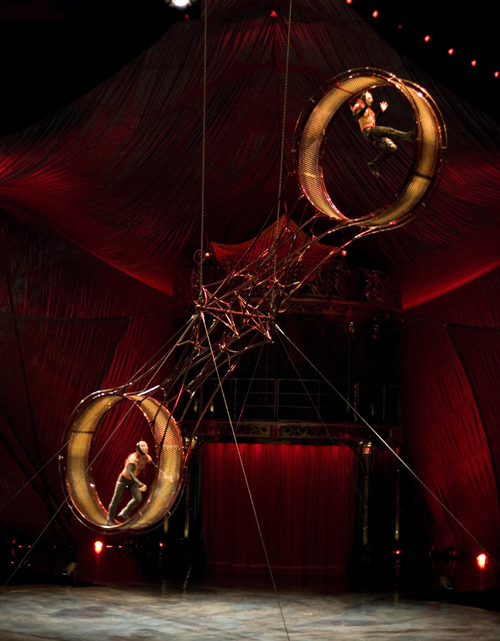
But they never cease to amaze for those reasons, as well. The double high-wire act was performed without the use of safety cables and without a net until the very last stunt. The chairs that were used for the high-balance did not appear to latch together like the ones in La Nouba clearly did. And the wheel of death? Gracious. This was the act that made me scream once with fright. Not only did the performers appear to attain zero-gravity while working this terrifying apparatus both on the interior and exterior of the circles, they jumped rope on them. It was madness, and possibly the most impressive thing I've ever seen. It's noted in the program that Cirque has never before used the wheel of death. It was well worth it.
Of course there's always the clowning factor. While the routines on stage were much more crude than any Cirque clowns that I have ever witnessed, the audience interaction was fantastic as always with shenanigans aplenty, including a clown dubbed The Pickpocket constantly being chased by "The Police." In the middle of the first act he went running through the crowd while onstage the performers lined up a confetti cannon. I was in the blast radius once, which was awesome, but in the end my best story of the night is that I got what one might call "popcorned." Twice. In Cirque there seems to be a tradition of having the clowns throw popcorn on the audience. I got popcorned before the show even started by a planted clown dressed like a tourist, and then later as well when the Pickpocket was running about. One might this this would be troublesome, but in the end, it's a part of the Cirque experience - almost a Cirque tradition - and I count myself fortunate to have gotten hit at Kooza.
I could go on for hours and hours about the set, the music, the costumes (some of which sported cogs - shoutout to all you fellow Steamheads out there), the acts, the control, the atmosphere in general, but it really is quite late where I am (or should I say early?) and so, I fear, I must bid you bon soir.
Cirque du Soleil Official site, including trailers, upcoming shows, and more!
[EDIT] A Side Note.
The packaging for the soundtrack is just about the coolest treatment of a CD case I've ever seen. Not only does the CD itself pop up upon opening the case - like a pop-up book - if you invert the first layer of this (entirely paper) case, it transforms into the box which appeared onstage, the box delivered to Innocent in the beginning of the show, that very same box which Trickster emerged from in all her splendor. I approve of this. Very much indeed.
Also the music is fabulous. Check it out.
-The Management
Cirque du Soleil's latest Portland-faring show is the jovial, terrifying, truly awe-inspiring Kooza! This show made me laugh, nearly cry, scream profusely in recognition and support, and scream once from sheer disbelief and fright.
To begin, one of the things that I love about every Cirque show - Kooza included - is how visually appealing they are. Every single one has themes, repetition and association, and also contradictions which help to tie the show together as a whole. The performers play just as much a role as the lighting, costuming, and set do. In every Cirque show I have ever seen, I find myself fixating on one to a few characters. I sadly don't have much recollection of Saltimbanco or Alegria, but in Varekai I remember the "twin birds," (as I referred to them), the contortionist caterpillar-turned-butterfly, the lizard who prowled the stage, and, of course, Icarus. In Corteo I couldn't get away from the white clown for his demeanor and grace, and I equally couldn't get my eyes off the singer, having both respect for his voice and his physicality as he sang. In Kooza, my eyes were glued to Trickster. The performer I saw for this role was clearly an understudy - it was a lady, rather than a man, as in all the advertisements and programs - and I would credit her, but my program, shockingly, does not list her at all. Not only was her costume fun, the persona she took on with her motions was amazing. I don't think I have ever seen that much presence in a role that never once speaks. In fact, I think the only sound she made was fabulously evil laughter right before the lights blacked out for intermission. Anyway, the point of this tangent is that Cirque performers continue to amaze me for their presence on stage as characters, not just as incredible feats of balance, strength, flexibility and coordination.
But they never cease to amaze for those reasons, as well. The double high-wire act was performed without the use of safety cables and without a net until the very last stunt. The chairs that were used for the high-balance did not appear to latch together like the ones in La Nouba clearly did. And the wheel of death? Gracious. This was the act that made me scream once with fright. Not only did the performers appear to attain zero-gravity while working this terrifying apparatus both on the interior and exterior of the circles, they jumped rope on them. It was madness, and possibly the most impressive thing I've ever seen. It's noted in the program that Cirque has never before used the wheel of death. It was well worth it.
Of course there's always the clowning factor. While the routines on stage were much more crude than any Cirque clowns that I have ever witnessed, the audience interaction was fantastic as always with shenanigans aplenty, including a clown dubbed The Pickpocket constantly being chased by "The Police." In the middle of the first act he went running through the crowd while onstage the performers lined up a confetti cannon. I was in the blast radius once, which was awesome, but in the end my best story of the night is that I got what one might call "popcorned." Twice. In Cirque there seems to be a tradition of having the clowns throw popcorn on the audience. I got popcorned before the show even started by a planted clown dressed like a tourist, and then later as well when the Pickpocket was running about. One might this this would be troublesome, but in the end, it's a part of the Cirque experience - almost a Cirque tradition - and I count myself fortunate to have gotten hit at Kooza.
I could go on for hours and hours about the set, the music, the costumes (some of which sported cogs - shoutout to all you fellow Steamheads out there), the acts, the control, the atmosphere in general, but it really is quite late where I am (or should I say early?) and so, I fear, I must bid you bon soir.
Cirque du Soleil Official site, including trailers, upcoming shows, and more!
[EDIT] A Side Note.
The packaging for the soundtrack is just about the coolest treatment of a CD case I've ever seen. Not only does the CD itself pop up upon opening the case - like a pop-up book - if you invert the first layer of this (entirely paper) case, it transforms into the box which appeared onstage, the box delivered to Innocent in the beginning of the show, that very same box which Trickster emerged from in all her splendor. I approve of this. Very much indeed.
Also the music is fabulous. Check it out.
Subscribe to:
Posts (Atom)