This was one of the many films we watched in my English GLBT literature class.
Released in 2007, Freeheld was directed and produced by Cynthia Wade, with the help of additional producers Matthew Syrett and Vanessa Roth. It has won several awards, including the Academy Award for Best Short Documentary in 2008. Significant, suspenseful, and heartfelt, the documentary tells the story of Lieutenant Laurel Hester, a policewoman dying of lung cancer who is, despite it, fighting for the right to leave her pension to her partner, Stacie against the ruling of the Ocean County, New Jersey Board of Chosen Freeholders.
This film is shot with a brutal sort of honesty. Little is withheld, especially with regards to the physical and emotional deterioration of both Laurel and Stacie as their - and their community's - campaign against the Freeholders goes on. While Freeheld can be very empowering in the regard that a community comes together to try and make a difference in the face of adversity and discrimination, it is also starkly grounding: after all, 2007 was not that long ago.
I would recommend this film for all of these reasons, especially for its down to earth, unyielding honesty about the nature of communities, the nature of the American court system of not very long ago at all, and especially the nature of the human condition at its most sensitive time - at its close.
Additional Information at:
IMDb
Wikipedia
Tuesday, November 16, 2010


Tuesday, November 2, 2010
Fun Home, by Alison Bechdel
I'm not even sure I can form fully coherent sentences at this point. This Tragicomic (as it calls itself) is a shocking, poignant masterwork.
Alison Bechdel is perhaps best recognized for her long-standing comic strip, Dykes to Watch Out For, but her memoir graphic novel Fun Home is what has made her name "household." Having been published now in multiple languages, Fun Home sat atop the New York Times' hardcover nonfiction bestseller list for two weeks and was reviewed positively by a slew of publications including but by no means limited to The New York Times, Seattle Times, and London’s The Times. It has also received a slew of awards, such as the GLAAD Media Award for Outstanding Comic Book, the Publishing Triangle-Judy Grahn Nonfiction Award, the Stonewall Book Award for non-fiction, and the Lambda Literary Award for "Lesbian Memoir and Biography".
One of the many parts of this comic and/or graphic novel I enjoyed the most was that the narrative is decidedly nonlinear. I have come, in retrospect, to perceive this work as occurring in concentric circles on the face of recollection, like ripples perhaps, all stemming from the singular event which spawned them. (No spoilers this time: I can't bring myself to. If you're curious you'll just have to go and read it.) However, I think the aspect which I enjoyed most was the manner in which the story was told as it pertains to other literary works. Although Bechdel's use of literary reference in Fun Home has been criticized, I think it is wildly significant. It highlights one of the few qualities that link her and the other central character, her father, intrinsically, and it puts special emphasis on the manner of her own self-creation. In addition it demonstrates an exceptional attention to detail, and a rather profound understanding of stories which are far from simplistic [like Ulysses].
In all, Alison Bechdel's Fun Home is more than worth it. Looking back on it now, I can't wait to read it again.
Here's a link to Alison Bechdel's Website
Looking for a copy? Try Amazon!
Alison Bechdel is perhaps best recognized for her long-standing comic strip, Dykes to Watch Out For, but her memoir graphic novel Fun Home is what has made her name "household." Having been published now in multiple languages, Fun Home sat atop the New York Times' hardcover nonfiction bestseller list for two weeks and was reviewed positively by a slew of publications including but by no means limited to The New York Times, Seattle Times, and London’s The Times. It has also received a slew of awards, such as the GLAAD Media Award for Outstanding Comic Book, the Publishing Triangle-Judy Grahn Nonfiction Award, the Stonewall Book Award for non-fiction, and the Lambda Literary Award for "Lesbian Memoir and Biography".
One of the many parts of this comic and/or graphic novel I enjoyed the most was that the narrative is decidedly nonlinear. I have come, in retrospect, to perceive this work as occurring in concentric circles on the face of recollection, like ripples perhaps, all stemming from the singular event which spawned them. (No spoilers this time: I can't bring myself to. If you're curious you'll just have to go and read it.) However, I think the aspect which I enjoyed most was the manner in which the story was told as it pertains to other literary works. Although Bechdel's use of literary reference in Fun Home has been criticized, I think it is wildly significant. It highlights one of the few qualities that link her and the other central character, her father, intrinsically, and it puts special emphasis on the manner of her own self-creation. In addition it demonstrates an exceptional attention to detail, and a rather profound understanding of stories which are far from simplistic [like Ulysses].
In all, Alison Bechdel's Fun Home is more than worth it. Looking back on it now, I can't wait to read it again.
Here's a link to Alison Bechdel's Website
Looking for a copy? Try Amazon!
Thursday, October 28, 2010
Paris is Burning
I must ask for your forgiveness, world at large! I am presenting my reviews out of order. Fie and for shame!
Paris is Burning is a documentary I encountered through my English 227 class. Directed by Jennie Livingston and released in 1990, it chronicles the lives of New York's underclass of the late 1980s, namely the attendees of 'Balls' - events some of us might argue could be called Drag Shows. The film has received twelve very well-deserved awards, and is considered one of Miramax Films' earliest successes.
I think my favorite part of this documentary is that it presents the viewer with vocabulary - words like House, Reading, Shade, Voguing, and Mopping - and educates the viewer not only through explanations offered by the Ball-goers, but through demonstration. My second favorite part is that it represents so totally and unabashedly a slice of life which is so often swept under the carpet, and not just in the sense that it deals with people who have sexual, gender, or image identities which are counter to what is considered socially "normative." It also has a lot of statements to make about oppression based on other forms of identity, especially race. The quote that honestly stuck with me the most throughout the whole film speaks to all of the above. The shot, I recall, was of a young man standing on the sidewalk in the pseudo-night of New York city, and he said: "I remember my dad - he'd say you have three strikes against you in this world. Every black man has two - that they are black and they are male. But you're a black and you're a male and you're gay.... If you're gonna do this, you're gonna have to be stronger than you ever imagined." Something in those words, for me, epitomized the struggles prevalent in the whole film. Not even in the specifics of it, just in that simple phrase, "You're gonna have to be stronger than you ever imagined."
It's a wonderful piece of work. I would love to own it, to see it again, to talk to scores of people about it and get their thoughts. It made me want to go to New York and see what I can, two decades later, and sort through the city for traces of that culture.
Interested? Check it out!
IMDb
Wiki
Paris is Burning is a documentary I encountered through my English 227 class. Directed by Jennie Livingston and released in 1990, it chronicles the lives of New York's underclass of the late 1980s, namely the attendees of 'Balls' - events some of us might argue could be called Drag Shows. The film has received twelve very well-deserved awards, and is considered one of Miramax Films' earliest successes.
I think my favorite part of this documentary is that it presents the viewer with vocabulary - words like House, Reading, Shade, Voguing, and Mopping - and educates the viewer not only through explanations offered by the Ball-goers, but through demonstration. My second favorite part is that it represents so totally and unabashedly a slice of life which is so often swept under the carpet, and not just in the sense that it deals with people who have sexual, gender, or image identities which are counter to what is considered socially "normative." It also has a lot of statements to make about oppression based on other forms of identity, especially race. The quote that honestly stuck with me the most throughout the whole film speaks to all of the above. The shot, I recall, was of a young man standing on the sidewalk in the pseudo-night of New York city, and he said: "I remember my dad - he'd say you have three strikes against you in this world. Every black man has two - that they are black and they are male. But you're a black and you're a male and you're gay.... If you're gonna do this, you're gonna have to be stronger than you ever imagined." Something in those words, for me, epitomized the struggles prevalent in the whole film. Not even in the specifics of it, just in that simple phrase, "You're gonna have to be stronger than you ever imagined."
It's a wonderful piece of work. I would love to own it, to see it again, to talk to scores of people about it and get their thoughts. It made me want to go to New York and see what I can, two decades later, and sort through the city for traces of that culture.
Interested? Check it out!
IMDb
Wiki
Crush, by Richard Siken
And so, dear readers, I once again arrive at the place in my life wherein I can review things which I read for school!
I read Richard Siken's Crush for my English 227 class, which focuses on GLBT literary works. We started off the quarter with theory, reading essays by Gayle S. Rubin, Audre Lorde, Kobena Mercer, and Judith Butler. Crush was a breath of fresh air.
Although it was refreshing, it was by no means an easy read. And to say it is not an easy read does not mean it is not a quick read: indeed, I could hardly put it down. But I've begun in the middle. Let's go back to the beginning.
Crush has won multiple awards, including the Lambda Literary Award for Gay Men's Poetry in 2005. However, perhaps most notably, Crush was selected as the 2004 winner of the Yale Series of Younger Poets prize, which speaks volumes in more than one way. Firstly, the contestant cannot have been published previously, and the contestant must also be under the age of 40. Secondly, the winners of this award are usually what my Professor dubbed "conservative" in their work - read structured, straightforward, classical, metered - and Crush is the antithesis of all that word stands for in our language today. It speaks for the strength of the manuscript in and of itself, a strength I cannot and will never doubt. Siken's work is compared to Silvia Plath's - Crush to Ariel - and I can believe it.
In the foreword of the book, Louise Glück (one of the judges of the aforementioned contest, I believe) asserts "This is a book about panic." I think this much is true, but I think it is also so much more than that. Siken's masterful use of imagery and surrealism immersed me as a reader in the universe of Crush and in it I saw much more than panic: grief, loss, denial, resignation, anger, desperation, desire, lust, and hopelessness. Some of these may be synonymous and I might be responding with vague and nebulous ramblings (as I am wont to produce) that are snatching at the coattails of insight, but really I can have little other response. Crush captured me. Not only in its brilliant use of imagery but in blurring the lines between literal and figurative and its use of the surreal and the sudden. It whisked me along and even though I tried to take it slow to see what I could see, it will take many, many more readings to formulate a more coherent response to it than the one you, reader, just slogged through.
For the slogging, I apologize.
I hope, however, that you find a copy of Crush to read, and read it carefully. Honestly I think that anyone who considers themselves a poet, ever dreamed of being a poet, or likes to profess that they are a poet should be required to read this book. It is infinitely powerful and I know it has changed how I look at poetry. I think it could open a lot of doors.
And even if you do not consider yourself a poet, I would recommend this to you. There is something so simply, so intrinsically human within each and every piece that each is a gem, and yet one cannot be plucked out from amongst all the rest. They are one and whole and heartbreaking.
Thanks for reading, and enjoy.
I read Richard Siken's Crush for my English 227 class, which focuses on GLBT literary works. We started off the quarter with theory, reading essays by Gayle S. Rubin, Audre Lorde, Kobena Mercer, and Judith Butler. Crush was a breath of fresh air.
Although it was refreshing, it was by no means an easy read. And to say it is not an easy read does not mean it is not a quick read: indeed, I could hardly put it down. But I've begun in the middle. Let's go back to the beginning.
Crush has won multiple awards, including the Lambda Literary Award for Gay Men's Poetry in 2005. However, perhaps most notably, Crush was selected as the 2004 winner of the Yale Series of Younger Poets prize, which speaks volumes in more than one way. Firstly, the contestant cannot have been published previously, and the contestant must also be under the age of 40. Secondly, the winners of this award are usually what my Professor dubbed "conservative" in their work - read structured, straightforward, classical, metered - and Crush is the antithesis of all that word stands for in our language today. It speaks for the strength of the manuscript in and of itself, a strength I cannot and will never doubt. Siken's work is compared to Silvia Plath's - Crush to Ariel - and I can believe it.
In the foreword of the book, Louise Glück (one of the judges of the aforementioned contest, I believe) asserts "This is a book about panic." I think this much is true, but I think it is also so much more than that. Siken's masterful use of imagery and surrealism immersed me as a reader in the universe of Crush and in it I saw much more than panic: grief, loss, denial, resignation, anger, desperation, desire, lust, and hopelessness. Some of these may be synonymous and I might be responding with vague and nebulous ramblings (as I am wont to produce) that are snatching at the coattails of insight, but really I can have little other response. Crush captured me. Not only in its brilliant use of imagery but in blurring the lines between literal and figurative and its use of the surreal and the sudden. It whisked me along and even though I tried to take it slow to see what I could see, it will take many, many more readings to formulate a more coherent response to it than the one you, reader, just slogged through.
For the slogging, I apologize.
I hope, however, that you find a copy of Crush to read, and read it carefully. Honestly I think that anyone who considers themselves a poet, ever dreamed of being a poet, or likes to profess that they are a poet should be required to read this book. It is infinitely powerful and I know it has changed how I look at poetry. I think it could open a lot of doors.
And even if you do not consider yourself a poet, I would recommend this to you. There is something so simply, so intrinsically human within each and every piece that each is a gem, and yet one cannot be plucked out from amongst all the rest. They are one and whole and heartbreaking.
Thanks for reading, and enjoy.
Friday, October 8, 2010
Catherinette Rings - Steampunk Jewelry Wizard!
THIS IS A PROMO!!!
One of my favorite jewelery artists of all time, forever known to me as CatherinetteRings, is holding a giveaway! His work is absolutely exquisite. I admire his attention to detail most of all, and I honestly feel that his creativity shines through bright and clear in every single one of his creations. If any of you - Steampunk'r or no - want to enter his contest, all you have to do is pay a visit to his blog and leave a comment! Your name will be included in a drawing to win a whopping $215 worth of his work and there will be FOUR NAMES DRAWN!
Get 'em while they're hot, people. Seriously. Don't miss this.
Visit this page for more information, and don't forget to check his work out on etsy!
One of my favorite jewelery artists of all time, forever known to me as CatherinetteRings, is holding a giveaway! His work is absolutely exquisite. I admire his attention to detail most of all, and I honestly feel that his creativity shines through bright and clear in every single one of his creations. If any of you - Steampunk'r or no - want to enter his contest, all you have to do is pay a visit to his blog and leave a comment! Your name will be included in a drawing to win a whopping $215 worth of his work and there will be FOUR NAMES DRAWN!
Get 'em while they're hot, people. Seriously. Don't miss this.
Visit this page for more information, and don't forget to check his work out on etsy!
Thursday, September 23, 2010
Alegría!
live and in the Tacoma Dome!
My love for Cirque is everlasting and undying, but honestly I feel as though I idealized this show. Perhaps because it was the first show which I had any memento of, perhaps because I was so young when I first saw it, perhaps because I have grown up listening to its music, perhaps because it was and is and will always be ingrained in my mind in a way little else can be.
Alright. So I idealize it. Isn't that the nature of adoration?
For the sake of a bit of history, Alegría was seen for the first time in 1994, performed a decade after the birth of Cirque du Soleil itself. Alegría was proceeded by: La Magie Continue, We Reinvent the Circus, Nouvelle Expérience, Fascination, Saltimbanco, and Mystère. Of these, only Saltimbanco and Mystère are still performed. Even in the face of such previous and enduring excellence, this 1994 newcomer stands up for itself.
Alegría professes itself to be "a baroque ode to the energy, grace and power of youth," and I can believe it. The show speaks to lineage, the old and the new, and the dichotomies of black and white, secure power and endangering risk. And frankly, overall, it's a sensory wonder.
I think what stayed with me the longest, besides the music, was the appearance of the characters. I never forgot the White Lady, as I remember her, or The White Singer as she is called in the official literature.

And she was not the only one; I recalled fragments of the costumes and characters from when I first saw them, and that in and of itself attests to the sheer beauty of this production. I remember parts of Alegría more vividly than I recall my childhood trips to Disney parks. But enough reminiscing.
Alegría in the Tacoma Dome was wonderful. I was a little sad they didn't fit the Big Top, or, if you prefer to be all fancy, the Grand Chapiteau, inside the Dome, but who am I to split hairs? The stage, lighting, MUSIC [especially the music] were spot on. There's just a quality that Alegría's music has which makes it both chilling and enthralling. I've never been able to escape it. Alongside the costumes, the music is my favorite part.
I think these factors are what redeemed the second viewing of this show for me. Since, quite naturally I would argue, nothing can ever live up to the idealized Alegría of my childhood and my dreams, in a way it had to be redeemed. Some of the acts were not quite so impressive to me the second time around, especially when stood up next to the far more recent KOOZÄ! (2007), which some of you might recall I saw last summer. But my discomfort was not in that I wasn't quite impressed or enthralled "enough" - but instead that KOOZÄ! seemed to loom in and even usurp Alegría's place in my heart. But not to fear - the Coup of the Circuses never took place. After all, Alegría had seniority and the fact that I debated at all attests to how well it has withstood the test of time.
Both of these shows have wonderful messages, which is always an important aspect of my appreciation of productions such as these. To me, KOOZÄ! is a call to embrace what some might call childishness, to be sensitive to mysticism and the unknown and to strike out in the world unafraid of inventing that world as one goes along; Alegría on the other hand is a testament to that youth, a celebration of things new and fresh while still embracing what has been. I realize now that I love both these shows so much because they walk hand in hand.
But as all of you know, I can go on about the things I care for the most for days, and none of you want that.
For those of you who are so inclined, seek out Alegría. It has the best clowning I have ever seen, some of the best music and costumes, and, as a bonus, one of my favorite acts of all time: the Flying Man.
I will leave you, then, with this:
Alegria
I see a spark of life shining
Alegria
I hear a young minstrel sing
Alegria
Beautiful roaring scream
Of joy and sorrow,
So extreme
There is a love in me raging
Alegria
A joyous,
Magical feeling...
Also! Credit must be given where it is due! I made use of this lovely timeline posted by a fellow blogger! Thank you ever so much for your marvelous compilation of Cirque materials!
My love for Cirque is everlasting and undying, but honestly I feel as though I idealized this show. Perhaps because it was the first show which I had any memento of, perhaps because I was so young when I first saw it, perhaps because I have grown up listening to its music, perhaps because it was and is and will always be ingrained in my mind in a way little else can be.
Alright. So I idealize it. Isn't that the nature of adoration?
For the sake of a bit of history, Alegría was seen for the first time in 1994, performed a decade after the birth of Cirque du Soleil itself. Alegría was proceeded by: La Magie Continue, We Reinvent the Circus, Nouvelle Expérience, Fascination, Saltimbanco, and Mystère. Of these, only Saltimbanco and Mystère are still performed. Even in the face of such previous and enduring excellence, this 1994 newcomer stands up for itself.
Alegría professes itself to be "a baroque ode to the energy, grace and power of youth," and I can believe it. The show speaks to lineage, the old and the new, and the dichotomies of black and white, secure power and endangering risk. And frankly, overall, it's a sensory wonder.
I think what stayed with me the longest, besides the music, was the appearance of the characters. I never forgot the White Lady, as I remember her, or The White Singer as she is called in the official literature.
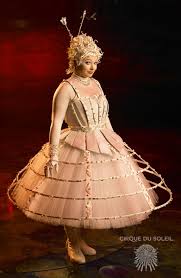
And she was not the only one; I recalled fragments of the costumes and characters from when I first saw them, and that in and of itself attests to the sheer beauty of this production. I remember parts of Alegría more vividly than I recall my childhood trips to Disney parks. But enough reminiscing.
Alegría in the Tacoma Dome was wonderful. I was a little sad they didn't fit the Big Top, or, if you prefer to be all fancy, the Grand Chapiteau, inside the Dome, but who am I to split hairs? The stage, lighting, MUSIC [especially the music] were spot on. There's just a quality that Alegría's music has which makes it both chilling and enthralling. I've never been able to escape it. Alongside the costumes, the music is my favorite part.
I think these factors are what redeemed the second viewing of this show for me. Since, quite naturally I would argue, nothing can ever live up to the idealized Alegría of my childhood and my dreams, in a way it had to be redeemed. Some of the acts were not quite so impressive to me the second time around, especially when stood up next to the far more recent KOOZÄ! (2007), which some of you might recall I saw last summer. But my discomfort was not in that I wasn't quite impressed or enthralled "enough" - but instead that KOOZÄ! seemed to loom in and even usurp Alegría's place in my heart. But not to fear - the Coup of the Circuses never took place. After all, Alegría had seniority and the fact that I debated at all attests to how well it has withstood the test of time.
Both of these shows have wonderful messages, which is always an important aspect of my appreciation of productions such as these. To me, KOOZÄ! is a call to embrace what some might call childishness, to be sensitive to mysticism and the unknown and to strike out in the world unafraid of inventing that world as one goes along; Alegría on the other hand is a testament to that youth, a celebration of things new and fresh while still embracing what has been. I realize now that I love both these shows so much because they walk hand in hand.
But as all of you know, I can go on about the things I care for the most for days, and none of you want that.
For those of you who are so inclined, seek out Alegría. It has the best clowning I have ever seen, some of the best music and costumes, and, as a bonus, one of my favorite acts of all time: the Flying Man.
I will leave you, then, with this:
Alegria
I see a spark of life shining
Alegria
I hear a young minstrel sing
Alegria
Beautiful roaring scream
Of joy and sorrow,
So extreme
There is a love in me raging
Alegria
A joyous,
Magical feeling...
Also! Credit must be given where it is due! I made use of this lovely timeline posted by a fellow blogger! Thank you ever so much for your marvelous compilation of Cirque materials!
The Dimes
live and in concert at Portland's Muddy Boot Festival!
I had wanted to see The Dimes desperately for over a year, and finally I was given the opportunity! Based in the Vancouver-Portland (Washington-Oregon) area, The Dimes have a flair for history and a good ear for indie pop/folk fusion. Last May they were recognized on NPR when their track Save Me, Clara was made song of the day. If it strikes your fancy you can read the honorary blurb by Barbara Mitchell, The Dimes: A Gentle Plea To An Angel Of Mercy.
The band is composed of Johnny Clay, Pierre Kaiser, Ryan Johnston, Jake Rahner, Kelly Masigat, Tucker Jackson and potentially several others, as they are quite happily prone to including family members and guest stars for various performance purposes. They are self-proclaimed college-campus-playing veterans, and have since moved on to higher prospects including the Crystal Ballroom [my personal favorite venue in all of Portland].
I think one of my favorite parts about the music they make is how very historical the lyrics are. For sake of example, Save Me, Clara is about Clara Barton, a nurse who tended the wounded during the Civil War and who later went on to found the American Red Cross. However, even though this is the case, the references made by the songs do not in any way make them inaccessible: you don't need to know that Clara is Clara Barton to enjoy the song. On their facebook page, the members of the band credit their song ideas to some 1930s era newspapers they found under the kitchen floorboards of a Victorian house they're renovating. (May I take a moment to say, how flippin' cool is that?!) But beyond having excellent lyrics, their sound is wonderfully balanced. I have a soft spot for their multi-harmony vocals, epitomized in their track Emmie Devine. And still beyond that, their sound translates from recording to live and in person very gracefully indeed. Hearing Emmie Devine live nearly reduced me to tears in the very best sense.
So if you haven't heard their work yet, Go Forth, blog readers, and be victorious!
Visit The Dimes on...
Their Homepage
Facebook
Myspace
Twitter
PS - This review is EXCEEDINGLY LATE. I APOLOGIZE. College decided to happen, so I'm really quite behind with this whole reviewing business. I will catch up as soon as I may (despite the fact that the holidays are well on their way)!
I had wanted to see The Dimes desperately for over a year, and finally I was given the opportunity! Based in the Vancouver-Portland (Washington-Oregon) area, The Dimes have a flair for history and a good ear for indie pop/folk fusion. Last May they were recognized on NPR when their track Save Me, Clara was made song of the day. If it strikes your fancy you can read the honorary blurb by Barbara Mitchell, The Dimes: A Gentle Plea To An Angel Of Mercy.
The band is composed of Johnny Clay, Pierre Kaiser, Ryan Johnston, Jake Rahner, Kelly Masigat, Tucker Jackson and potentially several others, as they are quite happily prone to including family members and guest stars for various performance purposes. They are self-proclaimed college-campus-playing veterans, and have since moved on to higher prospects including the Crystal Ballroom [my personal favorite venue in all of Portland].
I think one of my favorite parts about the music they make is how very historical the lyrics are. For sake of example, Save Me, Clara is about Clara Barton, a nurse who tended the wounded during the Civil War and who later went on to found the American Red Cross. However, even though this is the case, the references made by the songs do not in any way make them inaccessible: you don't need to know that Clara is Clara Barton to enjoy the song. On their facebook page, the members of the band credit their song ideas to some 1930s era newspapers they found under the kitchen floorboards of a Victorian house they're renovating. (May I take a moment to say, how flippin' cool is that?!) But beyond having excellent lyrics, their sound is wonderfully balanced. I have a soft spot for their multi-harmony vocals, epitomized in their track Emmie Devine. And still beyond that, their sound translates from recording to live and in person very gracefully indeed. Hearing Emmie Devine live nearly reduced me to tears in the very best sense.
So if you haven't heard their work yet, Go Forth, blog readers, and be victorious!
Visit The Dimes on...
Their Homepage
Myspace
PS - This review is EXCEEDINGLY LATE. I APOLOGIZE. College decided to happen, so I'm really quite behind with this whole reviewing business. I will catch up as soon as I may (despite the fact that the holidays are well on their way)!
Subscribe to:
Posts (Atom)